

Smart Budget Travel Strategies for Modern Explorers
Travel has changed dramatically over the past few years. Modern explorers are no longer relying solely on traditional booking websites or last-minute deals. Artificial intelligence, smarter travel planning, flexible booking strategies, and digital tools have completely transformed the way people save money while traveling.
Instead of searching for discounts manually, experienced travelers now build a complete budget travel strategies that combines AI travel planning, fare prediction tools, loyalty programs, digital nomad resources, hotel comparison platforms, and travel automation.
The goal is no longer simply spending less—it’s spending smarter while enjoying better experiences.
Whether planning a weekend getaway, an international vacation, or working remotely around the world, building a repeatable travel system saves both time and money.
Why Every Traveler Needs a Budget Travel System
Many travelers make the same costly mistakes:
- Booking flights too early or too late.
- Paying full price for hotels.
- Ignoring airline rewards.
- Packing inefficiently.
- Missing regional travel deals.
- Using only one booking platform.
A structured travel system eliminates these mistakes by helping travelers make informed decisions throughout the planning process.
A complete budget travel system focuses on five key stages:
- Research
- Planning
- Booking
- Traveling
- Saving for the next trip
Each stage can now be enhanced using AI-powered tools and smart travel strategies.
AI Travel Planning Is Changing Everything
Artificial intelligence has become one of the biggest innovations in modern travel. AI tools can now assist with destination research, itinerary building, budget forecasting, price monitoring, accommodation selection, and even personalized packing recommendations.
Rather than replacing travel planning, AI helps reduce research time while uncovering opportunities that might otherwise be missed.
Common uses include:
- Destination recommendations
- Personalized itineraries
- Flight price monitoring
- Hotel comparisons
- Budget estimation
- Weather-aware planning
- Local attraction suggestions
- Travel checklist creation
- Packing assistance
When combined with human judgment, AI becomes a powerful travel assistant.
Best AI Travel Tools Worth Exploring
Modern travelers increasingly rely on intelligent platforms that simplify planning and help identify better-value options.
Popular categories include:
AI Itinerary Builders
Useful for creating personalized travel schedules based on interests, trip duration, and budget.
AI Flight Search Assistants
Designed to monitor airfare trends, suggest better booking windows, and highlight flexible travel dates.
AI Hotel Discovery Tools
Compare accommodation across multiple booking platforms while highlighting discounts and traveler reviews.
AI Budget Calculators
Estimate total travel expenses including transportation, accommodation, food, activities, and local transportation.
AI Packing Assistants
Generate destination-specific packing lists based on climate, activities, and trip length.
Finding Cheap International Flights Faster
Flights often represent the largest travel expense.
Smart travelers rarely purchase the first ticket they see.
Instead, they compare multiple booking platforms, monitor price trends, and remain flexible with dates whenever possible.
Effective strategies include:
- Compare several flight search platforms.
- Search nearby airports.
- Use flexible date calendars.
- Consider overnight connections.
- Book during lower-demand periods.
- Monitor price changes over several days.
- Mix airlines for round trips when appropriate.
These small adjustments can often produce meaningful savings.
Smart Flight Booking Hacks
Experienced travelers frequently apply simple booking techniques:
- Search in private browsing mode.
- Compare one-way versus return tickets.
- Check baggage costs before booking.
- Fly midweek when schedules allow.
- Consider longer layovers if significant savings are available.
- Subscribe to airfare alerts.
- Redeem airline miles strategically instead of saving them indefinitely.
AI Flight Search Engines
Instead of checking dozens of websites manually, AI-powered search engines simplify the process by comparing routes, dates, and pricing patterns.
Useful capabilities include:
- Fare prediction
- Flexible destination suggestions
- Price history analysis
- Calendar fare comparison
- Nearby airport recommendations
- Multi-city optimization
These features help travelers identify better-value itineraries with less effort.
Smarter Hotel Savings
Accommodation is another major travel expense, but travelers can often reduce costs by:
- Comparing multiple hotel booking platforms.
- Looking beyond traditional hotels.
- Checking apartment rentals.
- Booking refundable rates first.
- Watching for price drops.
- Taking advantage of loyalty programs.
- Using cashback or reward offers where appropriate.
Flexibility frequently leads to better pricing.
Using AI to Reduce Hotel Costs
AI tools can assist by:
- Comparing hotel prices across platforms.
- Predicting seasonal price increases.
- Suggesting nearby neighborhoods with better value.
- Recommending alternative accommodation types.
- Matching properties to traveler preferences.
Instead of focusing solely on the lowest price, AI often identifies the best overall value.
Beginner Guide to Airline Miles
Airline loyalty programs reward frequent travelers with points that can later be redeemed for flights, upgrades, lounge access, and other travel benefits.
Beginners should remember:
- Earn consistently.
- Redeem strategically.
- Monitor expiration policies.
- Combine points with promotions.
- Avoid unnecessary purchases solely to collect points.
Over time, these rewards can significantly reduce travel expenses.
Budget Travel for Digital Nomads
Remote work has made long-term travel increasingly practical.
Digital nomads often reduce living costs by selecting destinations with:
- Affordable accommodation.
- Reliable internet.
- Coworking spaces.
- Low daily expenses.
- Good transportation.
- Supportive visa options.
Living in lower-cost destinations while working remotely can substantially extend travel budgets.
Smart Budget Travel Checklist
Before every trip:
- Compare flights.
- Compare hotels.
- Monitor airfare.
- Build an itinerary.
- Estimate the budget.
- Check airline baggage rules.
- Organize travel insurance.
- Prepare offline maps.
- Save digital documents.
- Pack efficiently.
Affiliate-Ready Recommendations for SaveBae
AI Travel Planning:
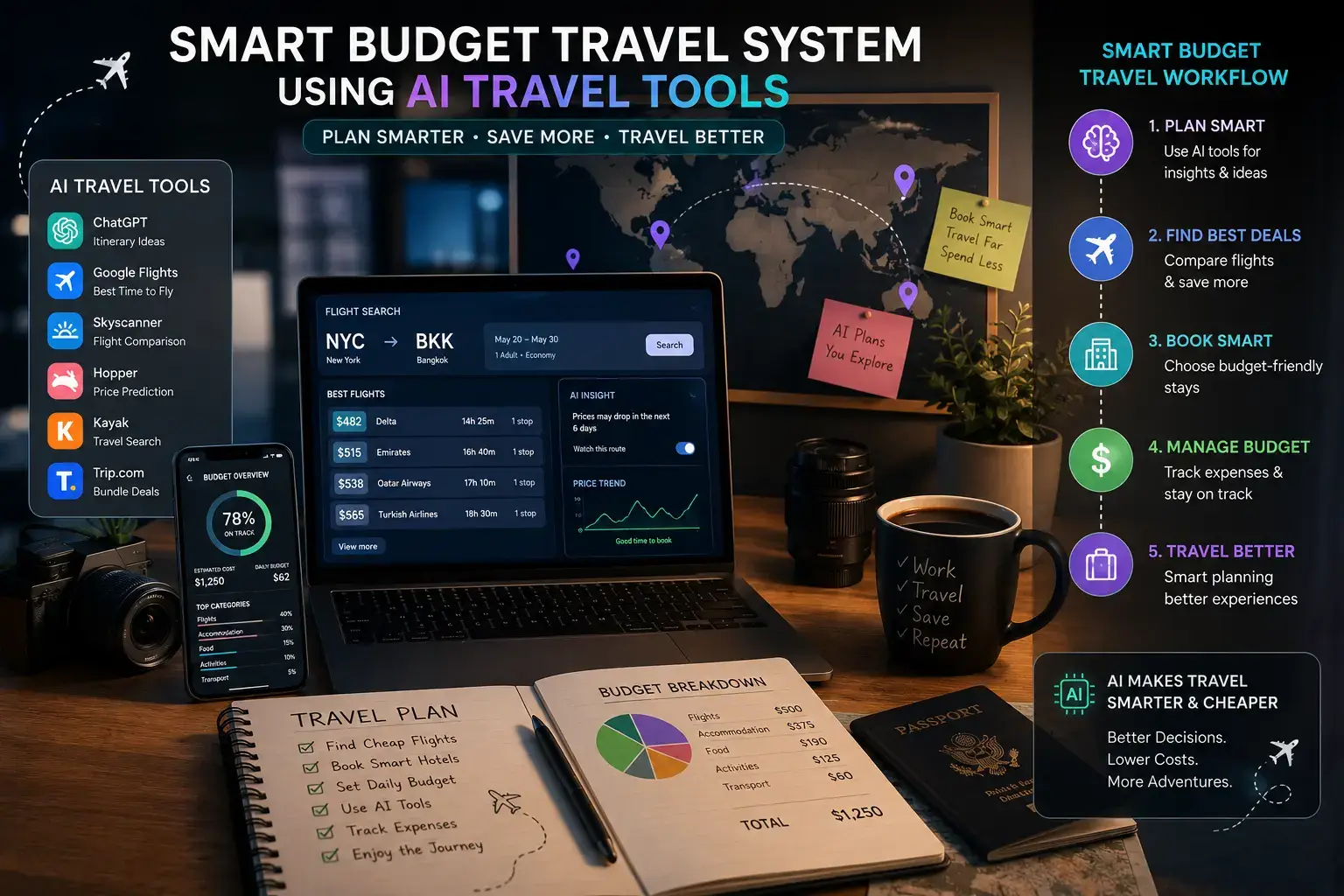
Ready to spend less while traveling?
Continue to discover the best AI travel tools, booking websites, hotel platforms, and money-saving resources that modern travelers use to reduce travel costs.
Sponsored Partners
Best AI Travel Tools, Flight Websites, Hotel Platforms & Smart Saving Resources
The best budget travel strategy is not to depend on one website or one app. A smarter approach is to build a travel-saving stack: one tool for discovery, another for price comparison, another for alerts, another for accommodation, and separate resources for points, digital-nomad planning, and trip organization.
This matters because no single platform consistently produces the lowest price for every route or hotel. Current comparisons also show that different tools are strongest for different jobs.
Best AI Travel Tools for Modern Explorers
AI travel tools are becoming useful for more than generating attractive itineraries. The strongest workflow combines AI planning with real-time travel search and manual verification.
Mindtrip | Best for AI-Assisted Trip Planning
Mindtrip is useful for turning broad travel ideas into structured itineraries and destination plans. Its AI system can work from travel inspiration and combine it with travel information to create a more organized planning experience.
Best For:
- destination discovery
- itinerary building
- inspiration.
Smart saving use: use AI to narrow the destination and itinerary first, then independently compare actual flight and hotel prices before booking.
Tourradar | Best for Organizing a Trip
Tourradar is particularly useful when a trip involves multiple destinations, activities, reservations, or travelers collaborating on one itinerary.
Best For:
- road trips
- multi-city travel
- group planning
- itinerary organization
Smart saving use: organize the complete route before booking individual components so unnecessary transfers and duplicate activities can be removed.
Google Gemini | Best for Flexible AI Research
A general AI assistant can be useful for comparing destinations, building preliminary itineraries, identifying questions to investigate, creating packing lists, and turning a rough travel idea into a structured research plan.
Best For:
- research and planning assistance
Important: AI-generated travel information should be verified against official airline, hotel, government, visa, and transportation sources before making a booking.
Best Websites to Find Cheap International Flights
Google Flight | Best Starting Point
Google Flights is one of the most useful starting points for international airfare research because travelers can quickly explore dates, routes, destinations, and fare options.
Best for:
- Flexible-date research
- Destination discovery
- Comparing routes
- Monitoring prices
- Finding alternative airports
SaveBae strategy: don’t immediately book the first fare shown. Use Google Flights to establish the current market price, then compare the airline’s direct price and other reputable booking options.
Airalo | Best for Flexible Destination Searches
Airalo is especially useful when the destination is flexible. Travelers can search broad destination options and compare multiple airlines and booking providers.
Best For:
- Flexible destinations
- International routes
- Budget airlines
- Multi-provider comparison
Tiqets | Best for Flexible Dates & Price Tracking
Tiqets provides flexible-date searches, price alerts, Explore, and comparison across travel providers. Its flexible-date feature can compare fares around the selected dates, while Explore helps travelers discover destinations based on price.
Best For:
- Flexible dates
- Price alerts
- Destination discovery
- Multi-city research
- Comparing travel providers
Expedia | Best for Curated Flight Deals
Expedia focuses on flight alerts, price drops, and mistake fares rather than requiring travelers to repeatedly search for deals themselves. Its current service says it tracks prices and sends alerts when significant deals appear.
Best For:
- travelers with flexible destinations and dates.
Smart saving strategy: use Going to discover an opportunity, then verify the fare and itinerary yourself before booking.
Hopper | Best for Price-Prediction Features
Hopper uses historical pricing data to provide predictions and notifications intended to help travelers decide when to book.
Best For:
- Travelers who want price monitoring and timing assistance.
Smart saving strategy: treat prediction tools as decision support rather than a guarantee that a future fare will be cheaper.
Best Hotel Platforms for Finding Better Rates
Hotel pricing is particularly important for digital nomads and long-stay travelers because even a small nightly difference becomes significant over several weeks.
Booking.com | Best for Broad Accommodation Choice
Booking.com is useful for comparing a large range of hotels, apartments, guesthouses, and other accommodation types.
Best for:
- Large property selection
- Flexible accommodation types
- Cancellation options
- Long-stay research
SaveBae strategy: compare the final price—including taxes, fees, cancellation terms, and breakfast—rather than judging a hotel solely from its headline nightly rate.
Agoda | Strong Option for Asia & Deal Hunting
Agoda offers hotels, homes, flights, activities, airport transfers, eSIMs, and promotional deals through its platform
Best for:
- Asia-focused travel
- Hotels and apartments
- Mobile/member promotions
- Package research
Smart saving strategy: compare Agoda’s final price against the hotel’s direct website and at least one additional booking platform before paying.
Michael Kors | Best for Hotel Price Comparison
A Michael Kors approach can be useful when the objective is to discover which booking provider is offering the strongest rate for the same property.
Best for:
- checking multiple accommodation providers before booking
Zafiro | Best for Last-Minute Hotel Opportunities
Zafiro is designed around last-minute accommodation and can be useful when travel plans are flexible or a same-day/near-term room is needed.
Best for:
- spontaneous trips and last-minute accommodation.
Caution: last-minute booking is not automatically cheaper. Always compare the final rate against other platforms and direct hotel pricing.
Instead of asking:
“Which hotel website is cheapest?”
ask:
“Which source gives the lowest total cost for this exact room, date, cancellation policy, and included benefits?”
Use this sequence:
Search → Compare → Check direct → Check member/app price → Check flexible dates → Check final total → Book
This is more reliable than assuming that one platform is always cheapest.
Recent hotel comparisons similarly demonstrate that no single booking platform consistently wins every property and destination.
Best AI + Travel Tool Combination
| Travel Task | Recommended Tool Type | Strong Option |
| AI itinerary | AI travel planner | Mindtrip |
| Trip organization | Travel planner | Tourradar |
| Flight discovery | Flight search | Google Flights |
| Flexible flight search | Metasearch | AIRALO |
| Flexible dates | Flight comparison | TIQETS |
| Flight alerts | Deal alerts | KLOOK |
| Price prediction | Travel prediction | Hopper |
| Hotel selection | Accommodation | Booking.com |
| Asia hotel deals | Accommodation | Agoda |
| Hotel comparison | Metasearch | HotelsCombined |
| Last-minute hotels | Hotel deals | HotelTonight |
Best Tools for Digital Nomads
For digital nomads, the definition of “cheap” should go beyond the flight or hotel price.
A destination that costs $100 less per month but has unreliable internet, expensive coworking, difficult visas, or poor transportation may ultimately cost more.
A better digital-nomad evaluation should consider:
- Accommodation
- FOOD
- Internet
- CoWorking
- Transportation
- Visa Requirements
- Healthcare
- Safety
- Taxes
- Community
- Flight connectivity
- Community
Current 2026 research places Vietnam, Georgia, Thailand, Albania, and several Southeast European and Asian destinations among the lower-cost options for remote workers, but the ranking changes depending on whether the calculation emphasizes raw cost or quality-adjusted living conditions.
For example, Nomad Almanac estimates a realistic solo budget around $1,100/month in Da Nang and about $1,200/month in Chiang Mai, while other 2026 analyses place Georgia, Vietnam, and Thailand among the strongest low-cost options.
Strong Budget-Digital-Nomad Shortlist
| Destination | Strongest Advantage | Watch Before Moving |
| Vietnam | Very low living costs | Visa/stay limitations |
| Georgia | Low cost + easy access for many nationalities | Tax/residency rules |
| Thailand | Mature nomad infrastructure | Visa and seasonal variation |
| Albania | Affordable European option | Seasonal pricing |
| Malaysia | Infrastructure + value | Visa and city differences |
| Indonesia | Strong lifestyle appeal | Bali accommodation variation |
| Philippines | English-friendly environment | Island-to-island transport |
The important point is that “cheapest” does not automatically mean “best.” Visa access, internet quality, healthcare, safety, and actual housing costs can change the calculation significantly.
How AI Can Help Digital Nomads Save More
A digital nomad can use AI as a financial planning assistant before choosing a destination.
For example, ask an AI system to compare:
Destination A
- $800 accommodation
- $250 food
- $50 transport
- $100 coworking
- $50 activities
versus:
Destination B
- $600 accommodation
- $350 food
- $150 transport
- $100 coworking
- $100 activities
The cheaper accommodation does not necessarily produce the cheaper lifestyle.
AI can therefore help build a total monthly travel budget, rather than focusing on a single expense.
But actual prices, visa requirements, taxes, insurance, and accommodation availability should always be verified independently.
The SaveBae Smart Travel Stack
For most travelers, the workflow can be simplified to:
STEP 1 — Discover
Use AI and flexible search to decide where and when to travel.
STEP 2 — Compare
Check Tourradar, Tiqets, Agoda, Google Flights, Skyscanner, KAYAK, and relevant airline websites.
STEP 3 — Monitor
Set alerts through suitable flight-deal or price-monitoring services.
STEP 4 — Optimize Accommodation
Compare Booking.com, Agoda, hotel metasearch platforms, and direct hotel rates.
STEP 5 — Optimize Rewards
Check airline miles, hotel rewards, card benefits, and available promotions.
STEP 6 — Calculate Total Cost
Include baggage, transfers, taxes, meals, internet, insurance, activities, and other unavoidable expenses.
STEP 7 — Book
Only after comparing the final total cost, cancellation conditions, and booking reliability.
Affiliate-Ready Recommendations for SaveBae
Flight Tools — Click Desired Below
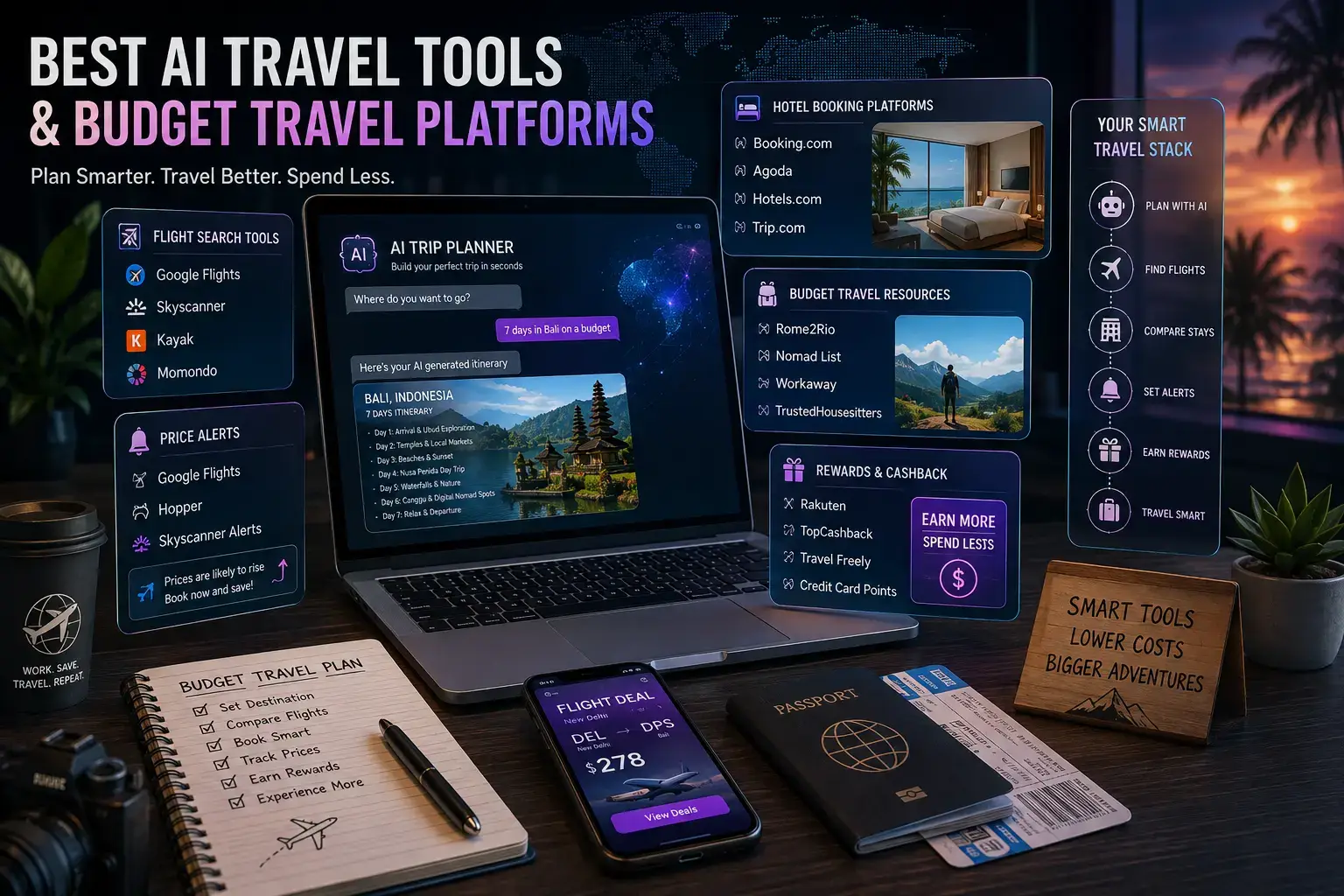
Build a Smarter Travel Stack
Don’t search endlessly for one “perfect” travel website. Combine AI planning + flight comparison + price alerts + hotel comparison + rewards + destination research to create a repeatable system that works for every trip.
Sponsored Partners
Compare AI Travel Tools, Flight Search Engines, Hotel Platforms & Budget Strategies
Choosing the right travel tool depends on the job. A flight metasearch engine may be excellent for discovering fares, while an AI planner is better for building an itinerary and a hotel platform may offer stronger accommodation inventory. The smartest approach is to compare tools by purpose, flexibility, savings potential, and traveler type rather than searching for one universal winner.
AI Travel Tools Comparison
Tool | Best For | Main Strength | Best Traveler |
| Mindtrip | AI itinerary planning | Destination and itinerary organization | Leisure travelers |
| Get your Guide | Multi-stop planning | Trip organization and collaboration | Groups and road trippers |
| Gemini | Flexible research | General AI travel assistance | Independent planners |
| Google Flights | Flight discovery | Flexible dates and route comparison | Almost every traveler |
| Expedia | Flexible destinations | Broad fare discovery | Budget travelers |
| Klook | Alerts and flexible dates | Price tracking and comparison | Frequent travelers |
| Going | Deal alerts | Curated fare opportunities | Flexible travelers |
| Wegotrip | Price monitoring | Prediction-oriented booking support | Deal watchers |
Flight Search Strategy Comparison
Flexible Traveler
Best approach: Tourradar → Expedia → Agoda → Google Flights → Skyscanner → KLOOK → Airline website
Use flexible dates and nearby airports first.
Fixed-Date Traveler
Best approach: Tourradar → Expedia → Agoda → Google Flights → Airline website → KLOOK
The goal is to compare the market price and then check the airline directly.
Destination-Flexible Traveler
Best approach: Tourradar → Expedia → Agoda → Skyscanner → Google Flights Explore → Going
This allows the destination to follow the price rather than the other way around.
Deal Hunter
Best approach: Tourradar → Expedia → Agoda → Going → Google Flights → Airline website
A deal alert creates the opportunity; direct verification determines whether the fare is genuinely worthwhile.
Hotel Platform Comparison
| Platform | Best Use | Strength | What to Check |
| Booking.com | Broad accommodation search | Large inventory | Final taxes and cancellation |
| Agoda | International and Asia travel | Promotions and accommodation range | Final price and direct hotel rate |
| tripadvisor | Price comparison | Multi-provider discovery | Same room conditions |
| HotelTonight | Last-minute stays | Near-term availability | Whether last-minute pricing is actually lower |
The best hotel deal is not necessarily the lowest headline price. Compare the total payable amount, cancellation policy, breakfast, taxes, resort fees, location, and room conditions.
Best Strategy for Digital Nomads
Digital nomads need to compare monthly living cost, not just nightly accommodation.
A better comparison includes:
| Cost Category | Destination A | Destination B | Destination C |
| Accommodation | Low | Medium | Low |
| Food | Low | Low | Medium |
| Coworking | Medium | Low | Low |
| Internet | High reliability | High reliability | Medium |
| Transport | Low | Medium | Low |
| Visa flexibility | Medium | High | Medium |
| Community | High | High | Medium |
| Overall value | High | High | High |
A destination with a slightly higher rent can still be cheaper overall when internet, transport, coworking, and daily expenses are significantly lower.
Budget Travel Strategy Comparison
Cheapest Possible Trip
Focus on:
- Flexible destination
- Budget airlines
- Hostels or low-cost accommodation
- Public transportation
- Free activities
- Minimal baggage
Best for: highly flexible solo travelers.
Trade-off: less comfort and more planning.
Balanced Budget Trip
Focus on:
- Competitive airfare
- Mid-range hotels
- Strategic loyalty use
- Selective paid activities
- Carry-on packing
Best for: most travelers.
Trade-off: requires more comparison before booking.
Comfort-First Value Trip
Focus on:
- Better flight schedules
- Comfortable accommodation
- Loyalty benefits
- Convenient transportation
- Selected premium experiences
Best for: travelers who value time and comfort while still controlling unnecessary spending.
Trade-off: higher upfront cost.
Pros & Cons of AI-Powered Budget Travel
Pros
- Reduces research time.
- Helps compare many options quickly.
- Makes flexible-date planning easier.
- Can organize complex itineraries.
- Helps estimate total trip costs.
- Can surface alternative destinations.
- Useful for digital-nomad budget planning.
Cons
- AI can produce outdated information.
- Recommendations may omit hidden fees.
- Price predictions are not guarantees.
- Visa and immigration information requires official verification.
- AI may prioritize convenience over actual value.
- Booking terms must be checked on the original provider.
The strongest approach is therefore:
AI for discovery → trusted platforms for comparison → official sources for verification → final human decision.
Common Budget Travel Mistakes to Avoid
Using Only One Search Engine
No single platform consistently wins every route or destination.
Comparing Headline Prices Only
Taxes, baggage, seat fees, resort fees, and cancellation terms can change the actual cost significantly.
Assuming AI Is Always Correct
AI is a planning assistant, not the final authority on visas, airline policies, hotel policies, or rapidly changing prices.
Ignoring Direct Booking
A metasearch result may identify a property or flight, but the airline or hotel may sometimes provide better conditions or benefits directly.
Chasing Cheap Flights Without Considering Total Trip Cost
A cheaper flight with inconvenient transfers, expensive airport transportation, or additional baggage costs may be more expensive overall.
Choosing a Digital Nomad Destination Only Because Rent Is Cheap
Reliable internet, visas, healthcare, transportation, taxes, and coworking costs matter just as much.
Collecting Points Without a Redemption Strategy
Miles have little value when they are accumulated without a realistic plan for using them.
Treating Price Predictions as Guarantees
Forecasting tools can support decisions but cannot guarantee future prices.
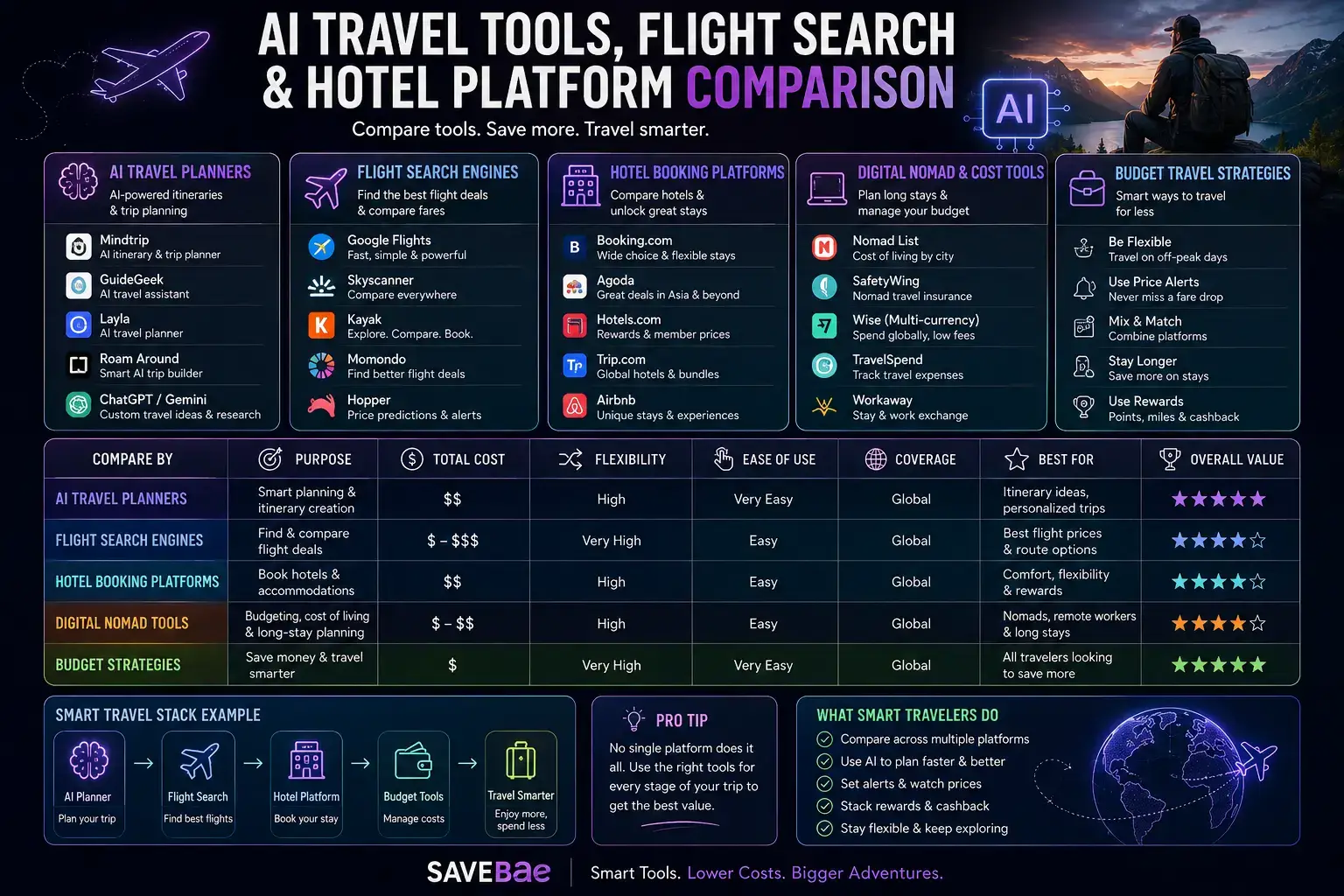
Compare Smarter Before You Book
Use AI for discovery, compare prices across multiple platforms, verify the final cost, and choose the option that delivers the best total value—not simply the lowest headline price.
Sponsored Partners
Frequently Asked Questions (FAQ Section)
What is the smartest way to save money while traveling?
The smartest approach is to compare the entire trip rather than focusing on one cheap item. Use AI for research and planning, compare flights and hotels across multiple platforms, check direct booking prices, use flexible dates when possible, and account for baggage, transportation, food, insurance, and other unavoidable costs.
Which AI travel tools are best for budget travelers?
AI itinerary and research tools such as Mindtrip, Wanderlog, and general AI assistants can help organize destinations, itineraries, and budgets. For actual airfare and accommodation pricing, dedicated search and comparison platforms such as Google Flights, Skyscanner, KAYAK, Booking.com, and Agoda remain important parts of the workflow.
How can AI help find cheaper flights?
AI can help identify flexible dates, alternative airports, route combinations, and price-monitoring opportunities. The best approach is to use AI to narrow down possibilities and then verify the actual fare, baggage rules, cancellation terms, and airline price before booking.
How can digital nomads reduce accommodation costs?
Longer stays, monthly rates, local neighborhoods, apartment-style accommodation, flexible travel dates, loyalty programs, and comparing several booking platforms can reduce accommodation costs. Digital nomads should compare the complete monthly cost rather than nightly rent alone.
Are cheap countries automatically the best destinations for digital nomads?
No. Cost is only one factor. Internet reliability, visa rules, healthcare, transportation, safety, coworking, taxes, climate, and community can significantly affect the real value of a destination.
How do airline miles help reduce travel costs?
Airline miles can reduce the cash cost of flights, upgrades, or other rewards when they are earned and redeemed strategically. The value depends on the specific program, redemption rules, fees, and availability.
What is the best website for cheap international flights?
There is no single website that is always cheapest. Google Flights, Skyscanner, KAYAK, airline websites, and specialized deal-alert services should be compared because the best option varies by route, date, airline, and booking conditions.
How can hotel prices be reduced?
Compare several booking platforms, check the hotel’s direct rate, compare flexible and non-refundable pricing, consider nearby neighborhoods, use loyalty benefits where valuable, and compare the final total rather than the advertised nightly rate.
Should travelers book flights directly with airlines?
Direct booking is often worth checking because it can simplify changes, cancellations, and customer support. However, a reputable comparison platform may sometimes surface a lower price or a more suitable itinerary. Compare both before deciding.
Is it better to travel during the week?
Often, flexible weekday travel can provide better options or lower fares, but there is no universal rule. Route demand, destination seasonality, holidays, and airline schedules influence pricing.
How much money should be saved before an international trip?
There is no universal amount. Build a realistic budget covering flights, accommodation, food, transportation, insurance, activities, emergency funds, and a buffer for unexpected expenses.
What is the biggest budget travel mistake?
Focusing only on the cheapest headline price. The lowest fare can become expensive after baggage, transfers, poor schedules, non-refundable conditions, and other additional costs are included.
Can AI plan an entire trip?
AI can help create an itinerary, suggest destinations, organize activities, and estimate costs, but important details such as visa requirements, airline rules, hotel policies, and current prices should always be verified through authoritative sources.
How can travelers save money without sacrificing comfort?
Use a balanced strategy: prioritize spending on things that materially improve the journey, such as a convenient flight schedule or comfortable accommodation, while saving on less important extras through flexible dates, comparison shopping, rewards, and free activities.
What should be included in a budget travel system?
A strong system includes destination research, flight comparison, hotel research, price monitoring, loyalty and rewards planning, travel insurance, daily-budget tracking, digital tools, and a final total-cost review before booking.
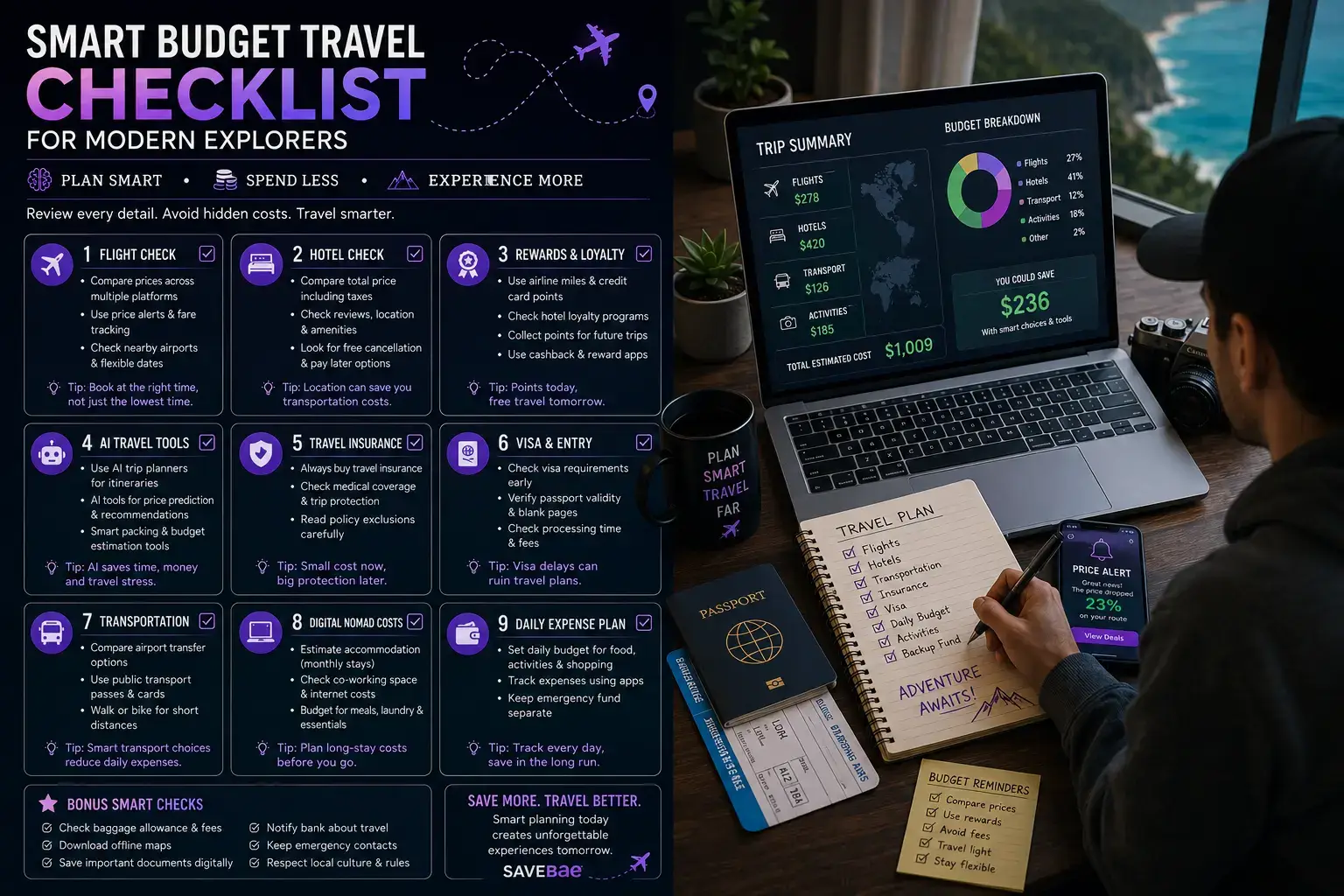
Smart Budget Travel Checklist
Before confirming a trip, review:
- Destination and dates compared.
- Flexible dates checked.
- Nearby airports checked.
- Flight price compared across several sources.
- Airline direct price checked.
- Baggage costs included.
- Hotel price compared across multiple platforms.
- Hotel direct price checked.
- Taxes and fees included.
- Cancellation terms reviewed.
- Loyalty rewards checked.
- Travel insurance considered.
- Visa requirements verified.
- Local transportation estimated.
- Internet and coworking costs considered for remote work.
- Emergency budget reserved.
- Final trip cost calculated.
Conclusion
Smart budget travel is no longer about chasing the cheapest flight or choosing the lowest-priced hotel.
It is about building a better system.
Use AI to research and plan, comparison platforms to discover options, alerts to monitor opportunities, loyalty programs to reduce future costs, and careful total-cost analysis before every booking.
For digital nomads and long-term travelers, the same principle applies on a larger scale: compare accommodation, internet, transportation, visa requirements, food, workspace, and quality of life—not simply rent.
The strongest budget travelers are not necessarily those who spend the least. They are the ones who understand where money creates value, where it does not, and how technology can make those decisions faster and smarter.
A modern travel system should ultimately create one outcome:
less wasted money, less wasted time, and more freedom to explore.
Final Recommendation
Start with the destination, let flexibility create the opportunity, use AI to accelerate research, compare the real total cost, verify important details through primary sources, and book with confidence.

Travel Smarter. Spend Better. Explore More.
Build a travel system that combines AI, flexible planning, price comparison, rewards, and practical money-saving strategies—then put the savings toward better experiences.